What Is ISO 42001? The AI Management System Standard Explained
ISO/IEC 42001 is the international standard for an artificial intelligenc...


Data classification is the foundation on which modern data security controls are built. When a file is labeled incorrectly, that mistake doesn’t stay confined to the classification system—it propagates through every downstream tool that relies on those labels to enforce security policies. DLP fires on them, access reviews are prioritized by them, and other controls use them to determine what data requires protection. Classification accuracy, in other words, sets the ceiling for every other data security control.
Pattern matching targets the easiest data to find. Social Security and account numbers follow predictable formats, whereas contracts, board materials, source code, and product roadmaps rarely match a rule. That content usually carries the most value.
Asking employees to label their own files places a security decision in the middle of someone else’s workday. Adoption often falls short, and the labels that do get applied are inconsistent enough that downstream policies inherit that inconsistency.
False positives cost more than misses. A classifier that floods the review queue gets tuned down until it stops flagging much of anything, and the program ends without anyone deciding to end it.
Classification is the decision that every other data security control inherits.
Most programs still make that decision using regular expressions and keyword lists, which work well for structured identifiers but poorly for everything else. A credit card number has a format. A separation agreement or an unreleased product spec has none, and those documents do real damage when they land somewhere they should never have.
The second common approach hands the decision to employees. Label your own documents, the policy says, and most people either pick the default or skip the step, because the person writing a quarterly forecast is thinking about the forecast.
Both approaches produce a classification layer that the rest of the security stack treats as authoritative. Every tool that reads them assumes the labels are correct, and none of them are designed to detect when they are wrong.
Data classification is the practice of determining what data an organization holds, how sensitive it is, and how it should be handled. Almost everything else in the stack depends on it.
Access reviews use it to work out which repositories deserve scrutiny. DLP uses it to decide what to block, retention schedules to determine what falls under which regulation, and AI governance to decide what a copilot should leave alone.
In practice, classification tools answer three questions:
The questions sound simple until you try to answer them across billions of files, in environments where the same nine-digit number serves as a customer identifier in one document and as a tax identifier in another.
Vendor accuracy claims all seem suspiciously close. Most quote a figure above ninety percent and measure it against structured identifiers in a controlled sample, which is the part of the problem that was already solved.
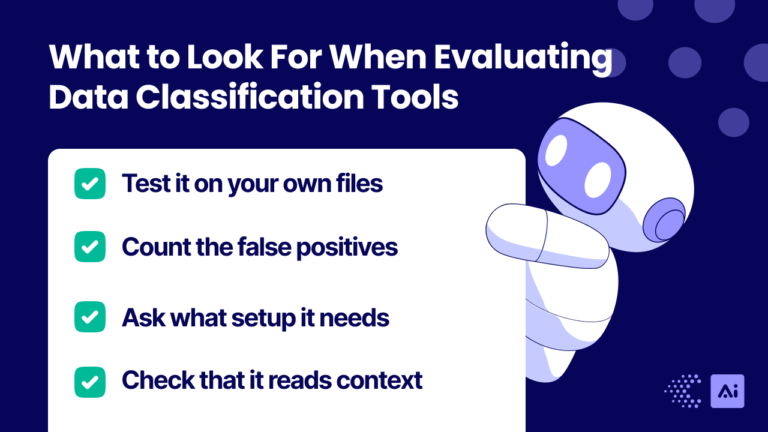
What you want instead is accuracy for your own unstructured content, measured against documents you’ve read yourself.
A few areas worth pressure-testing:
Pro tip: ask any vendor to run their classifier on a folder of your own documents during evaluation, then review the results yourself.
Every vendor below classifies data, and each started in a different data security discipline. Where they started may hint at where each tool performs best.
Concentric AI uses semantic analysis to determine what documents mean, identifying sensitive content by comparing files against the organization’s own body of similar documents rather than against rules or predefined patterns.
Microsoft Purview classifies through sensitive information types, trainable classifiers, and sensitivity labels that follow content across Microsoft 365 and into connected applications.
Spirion is built around classification accuracy for regulated data, with persistent classification and remediation actions tied directly to the results of its scans.
Netwrix provides classification as part of a broader data governance platform, using taxonomy and compound-term analysis to categorize content across file shares and Microsoft environments.
Sentra autonomously classifies cloud data stores, identifying sensitive data across cloud infrastructure without a manual tagging step.
| Vendor | Where It Stands Out | Potential Tradeoffs | Best Fit For |
|---|---|---|---|
| Concentric AI (Semantic Intelligence) | Platform that understands content and context without rules or sample documents required. It produces high accuracy on unstructured data that pattern-based tools consistently miss | Depth of analysis means initial deployment benefits from tuning to an organization’s data landscape | Organizations in highly regulated industries and those whose sensitive data lives in contracts, agreements, source code, and other business critical data records that don’t follow a pattern. |
| Microsoft Purview | Broad set of prebuilt sensitive information types, trainable classifiers, and labels that travel with content across the Microsoft ecosystem | Requires significant sample documents to train its model, and accuracy falls off outside Microsoft 365; label sprawl becomes its own maintenance burden over time | Organizations standardized on Microsoft 365 with the resources to build and maintain a labeling program |
| Spirion | Strong accuracy on regulated data types, with persistent classification and remediation actions tied to scan results | Rule and pattern foundations mean context-dependent content requires tuning; scanning large unstructured estates carries performance overhead | Organizations focused on regulated identifiers under HIPAA, PCI DSS, and similar frameworks |
| Netwrix | Classification integrated with permissions analysis and auditing, using compound term analysis across file shares and Microsoft environments | Taxonomy-driven approach requires ongoing rule maintenance, and classification depth trails the specialists in this category | Organizations that want classification bundled with access governance in a single platform |
| Sentra | Autonomous classification of cloud data stores with no manual tagging, deployed without moving data out of the environment | Cloud-focused, with limited coverage of on-premises file shares and legacy repositories | Cloud-native organizations classifying data across cloud infrastructure |
Classification has been a compliance checkbox for two decades, which is roughly how seriously most organizations treated it.
Regulators and AI put a hard stop to that line of thinking. Regulators began asking organizations to state what data they hold and prove it was protected, rather than simply describing a policy for handling it. AI assistants began retrieving content based on whatever the classification layer decided it was.
Consider a folder of executed customer contracts in SharePoint. A pattern-based classifier scans it, finds no credit card or Social Security numbers, and marks the contents unremarkable. The pricing terms, termination clauses, and customer names are invisible to it because none of that matches a rule. Every downstream control then treats those files as normal. DLP lets them out, and access reviews push the folder down the queue until a copilot summarizes it for whoever thinks to ask.
This is why classification keeps climbing the priority list:
Every one of those traces back to a single decision made much earlier and rarely revisited.
Data classification tools scan repositories, determine what the content is and how sensitive it is, and apply labels or categories that other security controls use.
Most platforms in this category are built to cover:
What separates the platforms here is accuracy at scale, since a classifier that performs well on a thousand files and poorly on a hundred million has solved nothing.
Datasheets in this category read almost identically. You find out which stands out the first time one of them reads a signed contract that contains no formatted identifiers at all.
Here are the core capabilities to look for:
Content analysis beyond pattern matching
Determine what a document is from its meaning, so sensitive content with no recognizable format still gets identified.
Context evaluation
Distinguish a blank template from a completed agreement, and a public price list from an unreleased one.
Regulatory categorization
Map findings to the frameworks that apply, including HIPAA, PCI DSS, GDPR, and regional privacy law.
Persistent labeling
Apply classifications that travel with the content and remain readable to other tools across the environment.
Continuous scanning
Reclassify as documents change, rather than producing a snapshot that ages out between scheduled scans.
Accuracy measurement
Report confidence and false positive rates openly, so the security team knows how far to trust a given finding.
Get these right and a scan result becomes something the rest of the security stack can build on.
Buyers in this category usually arrive with one of these needs:
Regulatory compliance
Frameworks including HIPAA, GDPR, and PCI DSS require organizations to know where regulated data lives before they can demonstrate control over it.
AI readiness
Before deploying Claude, Microsoft Copilot, or similar assistants, organizations need accurate classification so the tools they roll out know what to leave alone.
DLP and access policy accuracy
Both run on labels. Classification accuracy shows up directly in how many false positives a security team has to work through before they stop reading alerts.
All three depend on the same thing. Almost every other data security investment performs only as well as the classification underneath it.
Data classification overlaps with several established categories, and buyers constantly mix them up. Each one typically solves a different piece of the problem.
Classification vs data security posture management (DSPM)
DSPM identifies what sort of data an organization has and where it is located. Classification is a label that designates the sensitivity level of each data record and is often a feature of DSPM. DSPM solutions with higher accuracy in data identification will also be more accurate in assigning classification labels.
Classification vs data loss prevention (DLP)
DLP inspects content at exit points and blocks what policy prohibits. Those policies reference classifications, so a DLP deployment performs exactly as well as the labels feeding it.
Classification vs data access governance (DAG)
Access governance determines who can reach which files and whether that access is appropriate. Classification supplies the missing half of that judgment, since a permissions report ranks the lunch menu and the merger document identically without it.
Most organizations have run a classification project at some point, usually with the tools already in place.
The results are often quite predictable:
All four share one weakness. They sort documents by shape when sensitivity comes down to wording.
Most tools in this category classify by matching content against rules, patterns, or sample sets that someone has to build and maintain. That approach handles formatted identifiers well and leaves the rest to chance.
Powered by the Semantic Intelligence™ Engine’s patented language models, the platform discovers, governs, and protects business-critical and compliance-sensitive data at rest, in motion, and in use by AI, all under a consistent policy framework.
It analyzes and understands the meaning of data, comparing each document against the organization’s body of similar content to determine what it is and how sensitive it is. It works without rules to write, a taxonomy to design, or sample documents to supply, which is why it identifies the contracts, agreements, financial models, and source code that rule-based classifiers routinely miss.
Instead of returning a list of pattern matches, Semantic Intelligence provides clear visibility into:
When organizations classify accurately, every control built on top of that classification becomes more accurate. DLP blocks the right content, access reviews focus on the right repositories, and AI assistants operate inside boundaries that reflect what the data contains.
