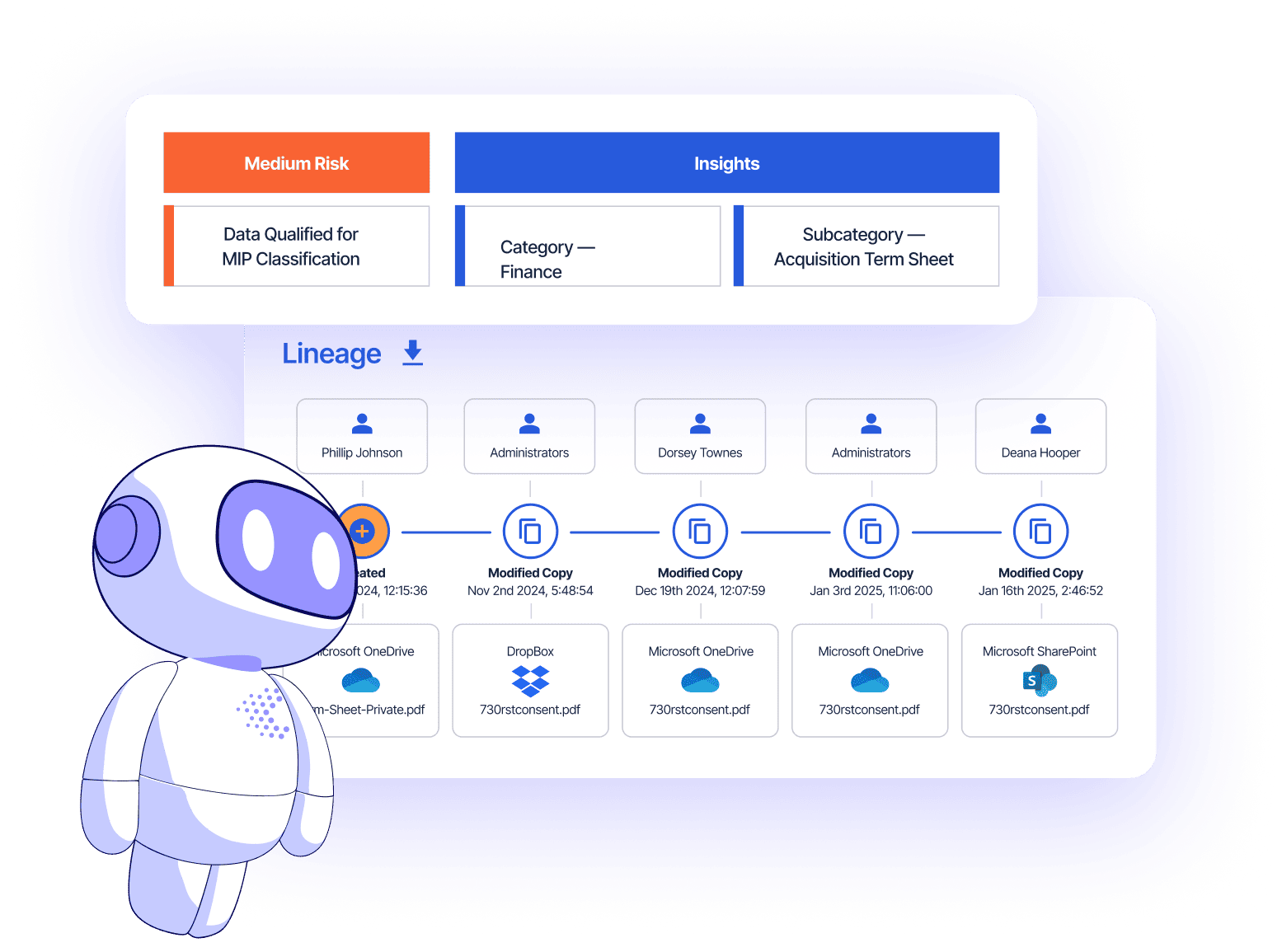
See where sensitive data goes, who touches it, and what happens along the way.
Concentric AI connects data intelligence with a complete record of activity, so you can understand what happened to your data, trace its journey, and pinpoint where risk entered.
Knowing that something happened isn't enough. Concentric AI connects every data interaction to the identity, action, and risk involved, giving security teams the context to distinguish routine activity from behavior that needs attention.
When sensitive data starts moving in the wrong direction, security teams need more than an alert. Concentric AI shows you who touched your data and what they did with it, so you can act before damage is done.
Recognized Vendor in Gartner® Market Guide for Data Security Posture Management (DSPM)
2026 Gartner® Peer Insights™ Customers’ Choice for Data Security Posture Management
319 Verified Reviews
Recognized Vendor for Information Governance in the Gartner® Market Guide for AI TRiSM
Find business-critical data, misplaced files, and oversharing risk, with clear insight into how to fix it.
Data detection and response (DDR) continuously monitors interactions with sensitive data to identify and respond to risky activity. Unlike network, endpoint, or application monitoring tools, DDR focuses on the data itself—specifically, who accessed it, what they did, and whether the activity poses a meaningful risk. Concentric AI combines real-time activity monitoring with data sensitivity, identity, and behavioral context to help security teams understand and respond to risky activity.
DLP uses policies and controls to prevent sensitive data from being shared or transferred in prohibited ways. Data detection and response adds visibility into what happens around sensitive data, helping identify anomalous or risky behavior that may not violate a predefined DLP policy. Concentric AI complements DLP by connecting data, user, activity, and risk context with remediation actions.
DSPM focuses on discovering sensitive data, determining where it resides, and identifying exposure and risk. Data detection and response adds a real-time activity layer that shows how users and identities interact with that data and helps identify unusual or risky behavior. Together, data intelligence and activity monitoring provide a more complete picture of data risk.
Concentric AI monitors activities including accessing, creating, modifying, downloading, copying, moving, sharing, and deleting data. Data lineage connects these interactions into a chronological view of the record's lifecycle, including the user, location, and timestamp associated with each event.
Yes. By connecting user activity to data sensitivity and behavioral context, data detection and response can help identify unusual or risky activity, whether intentional or accidental. Examples include excessive downloads, unusual access, privilege escalation, and unauthorized sharing of sensitive data.
Data lineage provides a chronological view of a data record’s entire lifecycle, from creation through subsequent interactions such as copying, editing, downloading, sharing, and deletion. Concentric AI connects each event to the user, location, and timestamp, giving security teams a complete view of how data moved and changed over time. This context helps investigators understand the sequence of events behind risky activity and determine where exposure may have occurred.
AI helps Concentric AI understand the data involved in an activity—not just the event itself. Patented language models analyze the meaning and context of data to identify sensitive information across structured and unstructured environments. That data intelligence can then be combined with real-time activity to help distinguish routine behavior from activity that warrants attention.
Data detection and response can provide visibility into interactions with sensitive data that occur as part of AI-related activity. By linking activity to the data involved and its sensitivity, security teams can better understand when sensitive information is accessed, moved, or shared in ways that may require action.
No. Data detection and response complements a SIEM rather than replacing it. SIEM platforms aggregate and correlate logs and security events across an environment, while data detection and response adds detailed context about sensitive data, the identities interacting with it, and the actions being taken.
Yes. Depending on the policy and activity type, Concentric AI can support response actions such as blocking downloads, preventing unauthorized sharing, and revoking access. These controls help security teams move from identifying risky activity to taking action.
Data detection and response focuses on data activity and risk, not employee productivity. Concentric AI provides visibility into interactions with sensitive data, enabling security teams to investigate activity that may pose meaningful risk without treating routine employee behavior as a security problem.