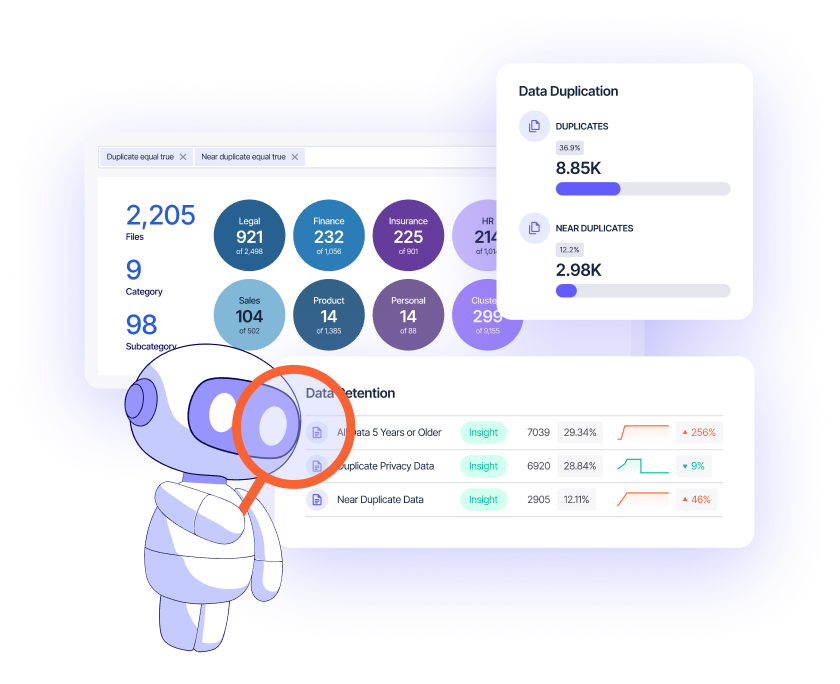
Data Has a Way of Multiplying
As information is created, copied, shared, and stored across the enterprise, your data estate continues to grow.
Continues to accumulate
Takes on new forms
Moves with the business
Keeping Track Gets Harder
As data grows and changes across the enterprise, it becomes increasingly difficult to know what you have, where it belongs, and what still matters.
Duplicates are everywhere
The same information can exist across multiple files, systems, and repositories, making it difficult to distinguish redundant copies from data that serves a legitimate purpose.
Context gets lost
As information is copied, transformed, and moved between environments, it becomes harder to understand its purpose, relevance, and relationship to other data.
Old data tends to stick around
Information can remain long after its original purpose has passed, leaving organizations managing data they may no longer need.
You need the context to understand what your data is, where it belongs, and what to do with it.


Understand Your Data Before You Start Managing It
The Semantic Intelligence™ Engine uses context to understand your data and determine what belongs and what doesn’t.
Understand what's there
Analyze entire data records—not just patterns or phrases—
to understand their context, meaning, and relationships.
Separate the redundant from the legitimate
Distinguish duplicate and near-duplicate data from legitimate instances of the same information across different business functions.
Act with precision
Use the platform’s Content Explorer and Similarity filters to identify data by category and subcategory, then create policies to delete, copy, or move it.
Put retention on autopilot
Set and enforce retention policies that determine where data should be stored, when it should be moved, and when it should no longer be retained.
Less Clutter. More Control.
Reduce the cost and complexity of managing data while keeping the information that matters.
Lower storage costs
Eliminate unnecessary data to reduce storage requirements and associated costs.
Improve productivity
Help employees find the right information without wasting time searching through redundant or unnecessary files.
Get rid of ROT
Identify and eliminate redundant, outdated, and unnecessary data to create a cleaner, more manageable environment.
Strengthen compliance
Enforce retention policies so data is managed according to organizational requirements and not kept longer than necessary.

Frequently Asked Questions
What is ROT data?
ROT stands for redundant, outdated, and trivial data—information that no longer provides meaningful business value but continues to consume storage, create management complexity, or increase risk.
How does Concentric AI identify ROT data?
Concentric AI uses Semantic Intelligence to understand data based on its context and meaning, helping identify duplicate, near-duplicate, stale, and unnecessary data records across the enterprise.
How does Concentric AI know whether data is truly redundant?
Rather than relying solely on pattern matching, Concentric AI analyzes the context of entire data records. This helps distinguish genuinely redundant information from legitimate instances of the same data used for different business purposes.
Can Concentric AI identify outdated data?
Yes. Concentric AI can help identify stale sensitive data that remains in the environment after its business purpose has passed, providing greater visibility into information that may no longer need to be retained.
What can I do with data identified as ROT?
Teams can use Content Explorer and Similarity filters to investigate data by category and subcategory, then create policies to delete, copy, or move information to an appropriate destination.
Can Concentric AI automate data retention?
Yes. Organizations can establish and enforce retention policies that determine where data should be stored, when it should be moved, and when it should no longer be retained.
How does data management reduce storage costs?
By identifying and eliminating unnecessary duplicate and stale data, organizations can reduce the amount of information they need to store and the associated storage costs.
How does Concentric AI improve data hygiene?
Concentric AI helps organizations reduce duplicate, near-duplicate, and stale sensitive data, creating a cleaner and more manageable data environment.
How does data management support compliance?
Retention policies help organizations manage how long data is kept and ensure information isn't retained longer than allowed.
Can data management help employees find information faster?
Yes. Reducing redundant and unnecessary information can make it easier for employees to locate the data they need, reducing time spent searching through cluttered data environments.
How is Concentric AI different from traditional deduplication tools?
Traditional deduplication approaches often focus on identifying matching data. Concentric AI uses semantic understanding to determine whether data is truly redundant or whether the same information exists in multiple places for legitimate business reasons.


