Microsoft Purview Optimization
Maximize Purview’s effectiveness with AI-powered intelligence.
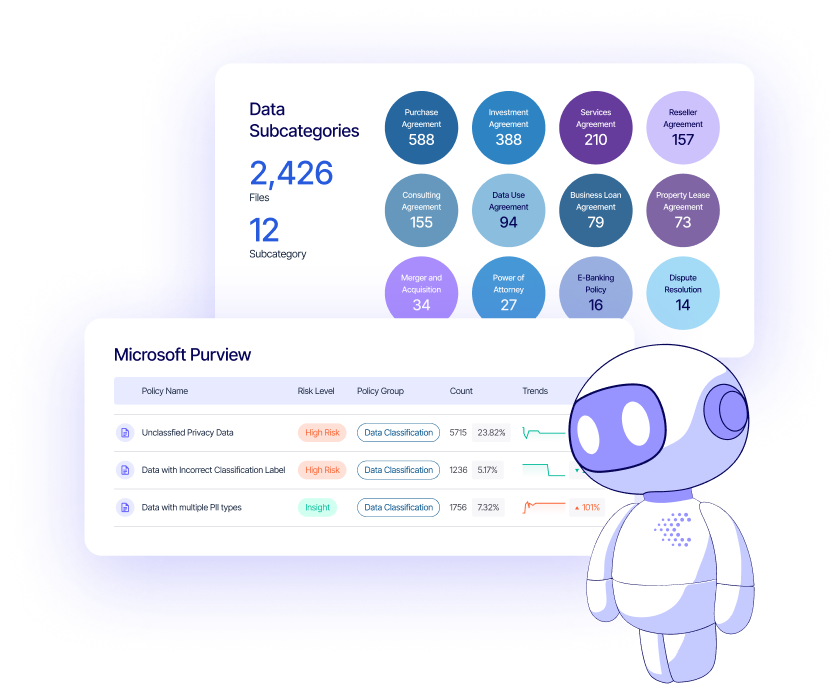
Purview is a Powerful Start
Microsoft Purview helps organizations understand, protect, and govern data across the Microsoft ecosystem.
One connected experience
One source of truth
One AI-ready foundation
Every Policy Starts With a Label
The accuracy of your classifications determines the effectiveness of every downstream policy and control.
Traditional methods have limits
Pattern matching and trainable classifiers can struggle to consistently identify business-critical information.
Training takes time
Many classification approaches require security teams to create and maintain hundreds of sample records to achieve reliable results.
Better labels create better outcomes
The reliability of your classifications directly affects sensitivity labels, policy enforcement, and governance decisions.
You need data intelligence that understands meaning, not just patterns.


Go Beyond Traditional Classification
Give Microsoft Purview richer intelligence to improve its understanding of your data.
Discover deeper data context
Gain visibility into enterprise data across thousands of categories and subcategories.
Classify based on meaning
Analyze data based on content, context, and business relevance—not just keywords or matching patterns.
Apply the right labels
Assign effective classifications and Microsoft Information Protection (MIP) sensitivity labels based on a semantic understanding of the data.
Turn insights into action
Connect contextual data intelligence with Microsoft Purview to enable more effective governance and protection policies.
Make Every Policy More Effective
Improve governance outcomes with stronger protection, smarter policies, and greater value from Microsoft Purview.
Improve policy accuracy
Apply governance policies with greater precision based on richer data context.
Protect sensitive information
Ensure sensitive information receives the right protections through more accurate MIP sensitivity labeling.
Reduce governance complexity
Spend less time manually managing classifications, reviewing exceptions, and maintaining outdated rules.
Strengthen Copilot governance
Identify which information is appropriate for Microsoft Copilot and apply stronger governance as AI adoption expands.
Maximize your Microsoft investment
Extend the value of Microsoft Purview with trusted data intelligence to support informed decisions.

Frequently Asked Questions
What is Microsoft Purview optimization?
Microsoft Purview optimization helps organizations maximize the value of their Purview investment by improving the data intelligence behind governance decisions. Concentric AI enhances Microsoft Purview with its Semantic Intelligence™ Engine that automatically understands data context, identifies thousands of categories and subcategories, and helps organizations apply more accurate classifications and Microsoft Information Protection (MIP) sensitivity labels.
Can Concentric AI work with existing Microsoft Purview deployments?
Yes. Concentric AI is designed to complement existing Microsoft Purview environments by providing richer data intelligence and more accurate classifications that can enhance governance, protection, and compliance workflows.
How does Concentric AI improve Microsoft Purview?
Concentric AI enhances Microsoft Purview by automatically understanding enterprise data at a granular level, identifying thousands of categories and subcategories, and providing the context needed to apply effective classifications and MIP sensitivity labels. This helps organizations strengthen data governance policies and make better-informed decisions.
What is the difference between Concentric AI categories and Microsoft Purview labels?
Categories describe what data is and provide granular insight into its content, context, and business relevance. Microsoft Purview sensitivity labels define how the data should be handled and protected. Concentric AI provides contextual understanding of data, helping organizations apply more accurate labels and governance policies.
Does Concentric AI assign Microsoft Information Protection (MIP) sensitivity labels?
Yes. Concentric AI can assign Microsoft Information Protection (MIP) sensitivity labels based on its contextual understanding of the data, helping organizations apply appropriate protections and improve governance across Microsoft environments.
Does Concentric AI require training data or sample records?
No. Traditional classification approaches may require organizations to provide sample records or build custom models to identify specific data types. Concentric AI uses proprietary LLMs to understand enterprise data without requiring extensive manual training.
How does Microsoft Purview optimization support Microsoft Copilot?
Microsoft Copilot relies on the data and permissions available within the Microsoft ecosystem. By improving Purview's classification accuracy, Concentric AI helps organizations better understand their data and enable secure Copilot adoption.
What types of data can Concentric AI analyze for Microsoft Purview?
Concentric AI analyzes structured and unstructured data across cloud, SaaS, and on-premises environments, including regulated information, intellectual property, financial records, customer data, legal documents, source code, HR information, and other business-critical content.


